
Full Front Access: Faster Battery Maintenance Without Removing the Shelter
Full front access battery shelter should be assessed as part of the complete infrastructure system. Poor access can turn a routine battery change into a complex intervention involving partial dismantling, awkward lifting and unnecessary time on site. A strong design must combine physical protection…
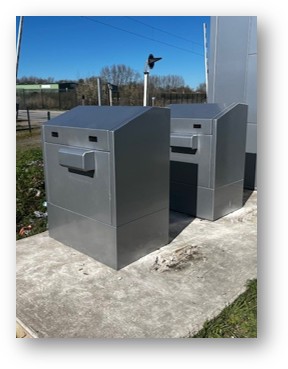
Full front access battery shelter should be assessed as part of the complete infrastructure system. Poor access can turn a routine battery change into a complex intervention involving partial dismantling, awkward lifting and unnecessary time on site. A strong design must combine physical protection with clear authorised access, suitable environmental treatment and a realistic installation method.
The SafeBox AVAC anti-vandalism battery shelter has been developed around those operational needs. Its main value is full frontal access and a design that allows batteries to be replaced without removing the shelter structure. The following guide explains what that means in practice and which project details should be confirmed before an order is placed.
SafeBox AVAC construction and security features
The SafeBox AVAC uses a reinforced welded steel structure rather than relying on thin folded panels alone. The side and rear panels are made from 2.5 mm galvanised sheet steel, while the inner door sheet is 3 mm thick. The frame is formed from 80 × 80 mm steel tube with a 3 mm wall. This gives the door, locking system and external panels a stable structural base.
Security is built into the enclosure layout. A four-point locking system uses 25 mm hardened steel bars. Hidden hinges reduce the opportunity for forced door removal, and there are no visible external assembly elements or externally accessible fixings. The internal opening arrangement can be adapted, subject to client validation, so authorised access can be aligned with the site’s operating procedure.
For outdoor durability, the welded assembly is hot-dip galvanised and protected by a C5M surface treatment with double primer and a powder-coated finish. These details are particularly relevant where the equipment is exposed to persistent moisture, industrial pollution, coastal air or other aggressive external conditions.
Maintenance access is part of the security design
Security controls work best when normal maintenance remains straightforward. If technicians cannot reach terminals, inspect the tray or remove a battery without dismantling unrelated parts, the site may accumulate temporary workarounds. Those workarounds can weaken security and create inconsistent asset configurations.
Full front access allows the maintenance sequence to be planned before manufacture. The project team can confirm the working envelope, equipment weights, lifting route, cable slack, isolation points and floor condition. The shelter can then be positioned so the doors and access area remain usable throughout the asset life.
Safety and project controls
The shelter is one component within a wider safe system of work. Site teams should use the client’s risk assessment, isolation, access, lifting and emergency arrangements. For wider guidance relevant to planning and maintenance, see Network Rail asset-management climate resilience plan. External guidance should be applied to the actual battery technology and site; it does not replace the equipment manufacturer’s instructions or the infrastructure manager’s requirements.
Before installation, confirm who is responsible for the slab, cable interfaces, equipment isolation, temporary protection and final inspection. During handover, record the keys, opening method, photographs, coating condition, tray condition and any approved site modifications. Clear records help the next maintenance team understand what was installed and why.
Checks to complete before order
- Verify the clear opening against the largest battery component.
- Allow safe pulling, lifting or sliding space in front of the unit.
- Keep cables supported and identifiable during replacement.
- Confirm door and tray loads for the intended maintenance method.
- Provide a clean working area around the slab.
These checks should be completed early enough to influence the design. Leaving them until installation day can lead to slab changes, restricted access, incompatible cable routes or unnecessary delay. A short technical review with the supplier is usually more valuable than relying on a generic product description.
Frequently asked questions
Can SafeBox AVAC replace an existing battery shelter?
Yes, it is designed for replacement applications, with existing concrete slabs reused or enlarged where site conditions allow. A survey is still required to confirm dimensions, condition, access and interfaces.
Can batteries be changed without dismantling the shelter?
The design provides full frontal access and allows battery replacement without removing the shelter structure. The final working space and handling method should be confirmed for the selected batteries.
Is every installation completed in two hours?
Approximately two hours is a typical installation figure, subject to site and operational constraints. Civil readiness, access, lifting, equipment protection and interfaces all affect the actual duration.
Conclusion
Full Front Access: Faster Battery Maintenance Without Removing the Shelter is ultimately about matching physical protection to real maintenance and site conditions. SafeBox AVAC combines reinforced galvanised steel, four-point locking, hidden hinges, C5M surface treatment, full front access and a retention tray in one purpose-built shelter. For a project-specific review, drawings or specification information, contact ALIAS Trading UK through the SafeBox AVAC product page.
ALIAS Engineering
We design and install modular enclosures for signalling, telecom and energy assets across European rail networks. Field notes from our installation teams are published here as they are cleared.