
Use Case: Improving Battery Maintenance Access with a Front-Opening Shelter
A maintenance-focused use case showing how full frontal access can simplify inspection and battery replacement without weakening the security concept.
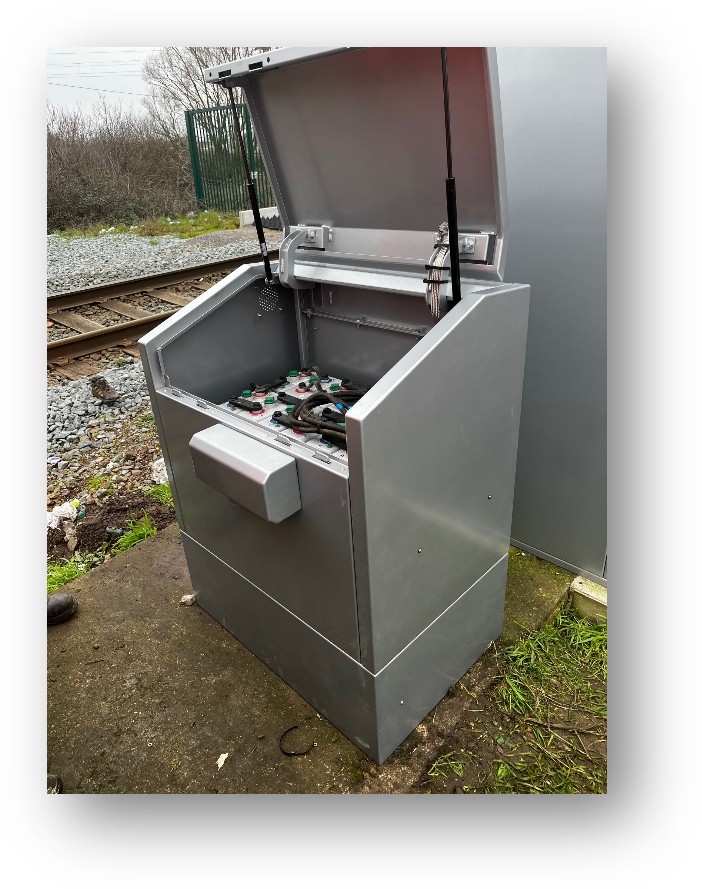
This is an illustrative engineering use case based on documented ALIAS product capabilities. It is not a named customer project, a site-specific design or a performance guarantee.
The maintenance problem
A battery installation may be technically functional but difficult to inspect. Restricted access can force awkward handling, increase the time spent at site and make it harder to examine terminals, containment areas and the condition of individual units.
The replacement shelter needs to improve access without introducing externally accessible fixings or obvious weak points.
Full frontal access
SafeBox AVAC is designed with full frontal access. This allows the maintenance opening to expose the working area from the front rather than relying on a narrow hatch or partial panel.
The phrase is intentionally stated as full frontal access, not as a percentage claim. Actual working access still depends on the installed battery arrangement, internal clearances and the space available outside the shelter.
Maintenance planning
- Confirm the dimensions and weight of batteries that may need to be removed.
- Provide adequate external working and lifting space.
- Check door opening, restraint and safe closing arrangements.
- Define access to terminals, cables, ventilation paths and the retention tray.
- Consider manual-handling aids and the route from the shelter to the maintenance vehicle.
- Ensure the opening device is suitable for authorised maintainers.
- Include isolation and testing requirements in the maintenance procedure.
Maintaining the security balance
Improved access should be available to the authorised technician, not to an attacker. SafeBox AVAC combines the front-opening arrangement with hidden hinges, no externally visible assembly elements and four-point locking using 25 mm hardened steel bars.
The final configuration should be reviewed for both access and attack resistance. A maintenance feature should not create an unprotected external fixing, removable panel or leverage point.
Retention and cleaning
The integrated retention tray should remain visible and accessible for inspection. Maintenance procedures should cover signs of leakage, residue, corrosion, damage and the condition of any internal supports.
The design should allow cleaning and inspection without requiring unnecessary dismantling of the shelter structure.
Installation considerations
A typical SafeBox AVAC installation is approximately two hours, subject to site and operational conditions. The maintenance-access benefit depends on the shelter being positioned correctly on the slab and on sufficient clearance being retained in front of the doors.
Site congestion, fences, trough routes or adjacent equipment can reduce usable access even when the cabinet itself opens fully.
Use-case outcome
The outcome is a secure battery shelter designed around the complete maintenance task rather than only around the closed external dimensions.
This can make inspection and replacement work clearer and more controlled, provided that the battery arrangement, site space and maintenance procedure are considered during design.
ALIAS Engineering
We design and install modular enclosures for signalling, telecom and energy assets across European rail networks. Field notes from our installation teams are published here as they are cleared.