
Use Case: Replacing an Ageing Battery Shelter at a Live Infrastructure Site
A SafeBox AVAC use case for replacing an ageing battery enclosure while planning safe access, equipment handling, retention and operational interfaces.
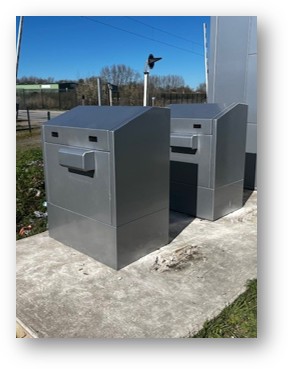
This is an illustrative engineering use case based on documented ALIAS product capabilities. It is not a named customer project, a site-specific design or a performance guarantee.
The existing asset
An ageing battery shelter protects batteries and associated equipment at a railway, telecoms, automation or energy site. The enclosure has become difficult to maintain and no longer provides the physical protection expected for the location.
The site remains operational, so the replacement must be coordinated with the asset owner’s electrical, operational and safety procedures.
Project objectives
- Provide a reinforced enclosure for batteries and associated equipment.
- Improve resistance to vandalism and forced-entry attempts.
- Maintain practical access for inspection and battery replacement.
- Integrate spill retention within the shelter arrangement.
- Limit civil engineering adaptations where the existing slab can be reused or enlarged safely.
- Complete the work within an agreed operational window.
Why SafeBox AVAC fits the use case
SafeBox AVAC is a secure battery shelter with a reinforced welded structure, four-point locking using 25 mm hardened steel bars, hidden hinges and no externally accessible fixings in the designed arrangement.
It includes full frontal access and an integrated retention tray, supporting maintenance and environmental-control requirements. C5M corrosion protection is specified for aggressive external environments.
Operational planning
The replacement method must be agreed with the asset owner. Battery isolation, temporary power, lifting, handling, ventilation, fire precautions and reconnection are site-specific matters and should not be inferred from a standard cabinet description.
The project team should define exactly which equipment is being retained, moved or replaced and who is authorised to carry out each task.
Indicative installation sequence
- Survey the existing shelter, batteries, equipment, slab, access and cable interfaces.
- Approve the replacement configuration, handling plan and operational method.
- Complete required isolation or temporary arrangements under the asset owner’s procedures.
- Remove the existing shelter and complete approved base adaptations.
- Install the SafeBox AVAC enclosure and retention arrangement.
- Transfer or install equipment in accordance with the approved technical method.
- Verify locking, access, ventilation, retention, labels and handover documentation.
Time and constraints
SafeBox AVAC has a typical installation time of approximately two hours, subject to site and operational conditions. This refers to the cabinet installation and should not be presented as the total duration for battery isolation, transfer, testing or site handback.
A realistic programme separates the enclosure installation from the wider electrical and operational activities.
Use-case result
The result is a replacement strategy that treats security, maintenance access, environmental retention and operational continuity as connected requirements.
SafeBox AVAC provides the physical shelter platform. The site-specific engineering method remains essential for battery safety, electrical interfaces and final commissioning.
ALIAS Engineering
We design and install modular enclosures for signalling, telecom and energy assets across European rail networks. Field notes from our installation teams are published here as they are cleared.